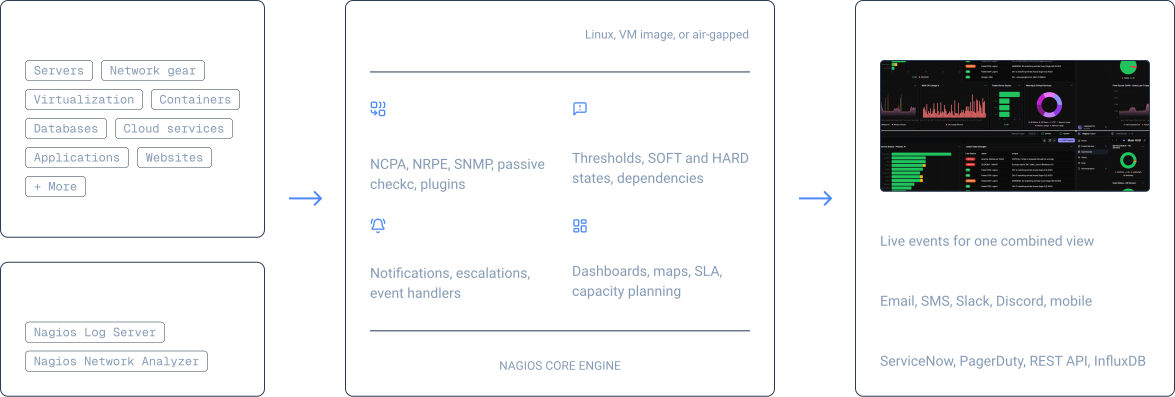
What XI collects, how it decides something is wrong, who it tells, and what it records. Grouped the way monitoring actually works, with the edition each feature needs.

Everything runs on one server you own. Data comes in, XI decides what matters, and the right people and tools hear about it. Select a stage to jump to its features.
Get data in from everything you run, with or without an agent.
Agents, agentless protocols, and pushed results, all on one XI server.
One token-authenticated HTTPS agent for Linux, Windows, macOS, Solaris and AIX. check_ncpa is a compiled C binary since 2026R1.7.

Existing agents work as-is and sit beside NCPA hosts in the same views.
Polling and traps. The SNMP Walk wizard groups OIDs by interface or MIB.
WinRM, SSH, ICMP, TCP, HTTP, and DNS for devices that can't run an agent.
NRDP and NSCA accept results over ports 80 and 443 with a token per sender.
Passive Results from hosts XI doesn't know yet are held so you can adopt them.
Any script that returns an exit code is a plugin. The Generic Plugin Wizard wraps it.
From a subnet scan to a monitored host without writing a config file.
Servers, network gear, virtualization, containers, databases, cloud, applications, and websites.
Scans a subnet with ping and nmap and feeds what it finds into a wizard.
Build your own wizard in the interface, or write one in the Declarative Wizard JSON format.
Assisted chat setup for websites, NCPA hosts, and SNMP hosts.
Pushes NCPA to the hosts you pick, or hands you an Ansible role.
Load long host lists, or edit every object and template directly in the CCM.
Every applied change is snapshotted and can be rolled back.
Decide what counts as a problem, and ignore what doesn't.
Every check returns OK, Warning, Critical, or Unknown against ranges you set.
Thresholds per check, so a disk at 85% and one at 98% are different events.
A check fails a set number of times before anyone is notified.
Hosts behind a failed router are marked unreachable instead of paging separately.
Objects stuck in a problem state past your limit are moved aside.
Projects performance data forward and can alert on the predicted value.
Services bouncing between states are flagged and their notifications held.
Track the service people use, not only the servers behind it. Best for clusters and multi-part apps, where some members can fail without taking the service down.
Group hosts and services, then set how much of the group can fail before it turns Warning or Critical.
Mark the parts that must stay up. If one fails, its group goes Critical, however healthy the rest is.
Groups can contain groups, so status rolls up from each instance to the whole environment.
The BPI Wizard turns a group into a single service, so you hear about the process, not every member.
Expand a red group to see exactly which member failed, fix it, and recheck it from its status page.
The host and service groups you already have become BPI groups automatically.
Report a whole process's availability against a target.
See alerts from BPI groups across several XI servers on one Nagios Fusion dashboard.
Reach the right person, fix what can be fixed, and hand the rest to your tools.
What happens after a HARD state change is configurable at every step.
Run a script on a state change, such as restarting a service, before anyone is paged.
Email with Microsoft OAuth2, SMS via Twilio or a Multi-Tech modem, Slack, Discord, and SNMP traps.
Change how, when, and for what events notifications will fire for groups of users.
Tiered escalations per host, service, or group when nobody acknowledges.
Repeat notifications stop once a person owns the problem.
Acknowledge straight from the link in a notification.
Each contact is only notified inside the hours they're on call.
Script XI from your own tools, and send alerts to the systems your team already works in.
Read, create, update, and delete hosts, services, users, and groups from a browser or cURL, using per-user API keys.
New servers are added as they're built. Ansible or your build pipeline calls the API, and monitoring starts without anyone logging in. Retired systems are removed the same way.
Ticketing, ITSM, chat, and automation tools such as ServiceNow, Jira, PagerDuty, Slack, Microsoft Teams, and Ansible connect through the REST API, notification commands, or event handlers.
Schedule or clear downtime, turn services off and back on, and run immediate checks across hosts or groups from a script.
Host, service, and performance data feed your own dashboards, BI tools, and trend reports.
Action URLs on any object, plus RDP, VNC, SSH, and Telnet links.
Give every team its view, and keep the evidence for every report.
Build the view each team needs and put it on the wall.
Variety of dashlet types, from graphs and gauges to treemaps and alert heatmaps.
Deploy to other users, publish globally, set as a home page, import and export.
Built automatically from check data. Graph Explorer stacks hosts and exports CSV.
Draws the parent-child topology on its own. The World Map places hosts by location.
Rotate dashboards, maps, and URLs on a timer, with Automatic Login for kiosks.
History is recorded from the first check. Reports email as PDF or CSV.
Uptime for any host, service, or group over any period.
Alerts, availability, and activity for people who never log in.
Traffic per interface over the period you choose.
What fired, when, and how often.
Availability measured against the target you committed to.
Export as a PDF, emailed on a schedule.
Run it where you want, at the size you need, with the controls auditors ask about.
A standard unlimited-Node instance handles roughly 10,000 to 20,000 checks at a five-minute interval.
One XI server for configuration, alerts, and reports.
Site servers forward results to a central XI server through NRDP or NSCA.
Workers pull checks from a queue on port 4730, so remote sites need no inbound access.
One view across many XI servers, with live events from 2026R2.
Limit who sees what, and record what they change.
Permission presets assigned to users.
Teams share on install and see only their assigned hosts and services.
Authenticate against Active Directory or LDAP over SSL.
Group-based provisioning, including US Government tenants.
Second factor on every XI login.
Interface, API, and engine activity in one log.
Content Security Policy headers and SameSite cookies since 2026R1.4.
Self-hosted on Linux. Licensed once, per Node.
Pre-built for VMware, VirtualBox, and Hyper-V.
RHEL, Oracle, CentOS Stream, Ubuntu, and Debian installation options available.
The offline installer ships with its dependencies.
Priced per Node, with unlimited Services on every Node.
Up to 7 Nodes or 100 Services, self-supported.
Every feature unlocked, no credit card. Support included.
Solutions that report into XI and into each other.
Combined view of many Nagios servers. XI 2026R2 forwards events to it.
Flow analysis and Suricata IDS, with a traffic tab on XI hosts.
Log search on OpenSearch. Its queries run as XI checks.
The agents XI collects from.
The open-source engine inside XI. Existing Core configs migrate in.
Both editions are perpetual and priced per Node, with unlimited Services. Enterprise is also an add-on to any Standard license.
| Feature | Standardfrom $2,595 | Enterprisefrom $4,690 |
|---|---|---|
| Wizards, Auto-Discovery, dashboards, graphs, REST API | Included | Included |
| Configuration snapshots and rollback | Included | Included |
| Availability, bandwidth, and executive summary reports | Included | Included |
| Scheduled reports and scheduled pages | Not included | Included |
| Service-Level Agreement (SLA) report | Not included | Included |
| Capacity Planning | Not included | Included |
| Advanced Business Process Monitoring | Not included | Included |
| Bulk modification, renaming, and notification settings | Not included | Included |
| Audit Log and Deadpool | Not included | Included |
| SNMP Trap Interface | Not included | Included |
Prices for 100 Nodes. Premium features (single sign-on, Remote Workers, Wizard Builder, and premium wizards) need active Maintenance & Support on either edition. Sitewide licenses include Enterprise features and Nagios Fusion.
We will email your download access link.